
Most students think the hard part is remembering the ± sign. It’s not. After teaching this for years, I’ve learned that the isolate step is what trips them up every time — and if you don’t teach that explicitly, everything else falls apart.
Irrational numbers. Imaginary numbers. Multi-step equations. Algebraic structure. All at the same time.
Earlier in our unit, we solved by graphing, by factoring, and by using the square root property in its simplest form. Each time, I hinted that not every equation would cooperate.
Over the years I’ve taught this several different ways. My original instinct was to organize by the type of solution — rational, irrational, complex. It seemed logical. Tidy, even. But eventually I noticed students weren’t struggling with what kind of answer they got. They were struggling with the structure of the equation itself. That one realization changed how I sequence everything.
My Original Structure: Chunking by Type of Solution
We would start with rational solutions:
- x² = 36
- (x – 5)² = 36
Then move to irrational solutions:
- x² = 8
- (x – 5)² = 8
After that, complex perfect squares:
- x² = –4
- (x – 5)² = –4
And finally, complex non-perfect squares.
On paper, it made sense. In practice, it didn’t. Students were managing two new things at once: an unfamiliar answer type and an unfamiliar equation structure. That’s too much cognitive load, and I kept seeing it in their mistakes.
My Current Structure: Chunking by Algebraic Complexity
Step 1 — Perfect Squares (Real and Imaginary)
- x² = 36
- x² = –4
The focus here is narrow on purpose: apply the property, remember ±, and meet imaginary solutions in the simplest possible context. No multi-step equations yet. Nothing competing for attention.
Isolation practice fits here too. An equation like 2x² – 4 = 28 is far easier to untangle than 2(x – 5)² – 4 = 28. Simple structure means students can focus on the algebra without the binomial throwing them off.
Step 2 — Non-Perfect Squares with Simple Structure
- x² = 8
- x² = –8
Now we add one new challenge: simplifying radicals. But the equation structure stays simple, so students can give that one skill their full attention. Managing i alongside a binomial equation is a lot — managing i in x² = –8 is not.
I always have students write both forms here — exact radical and approximate decimal. It reinforces that these are the same number, just expressed differently. And it starts building the habit before we need it on assessments.
Step 3 — Binomial Structure with Perfect Squares
- (x – 5)² = 36
- (x – 5)² = –4
Here’s where we introduce binomial structure — but keep the right side as a perfect square. Students are learning to apply ± and solve a two-step equation, without also simplifying radicals. One new layer at a time.
Step 4 — Binomial Structure with Non-Perfect Squares
- (x – 5)² = 8
- (x – 5)² = –8
This is the full picture. Isolate the binomial. Apply ±. Simplify the radical. Handle imaginary results if needed. By the time we get here, students have practiced each piece separately. Putting it together feels manageable instead of overwhelming.
Comparing the Two Approaches
| Approach | Strengths | Challenges |
|---|---|---|
| Chunking by Solution Type | Builds vocabulary and makes categories clear. | Switches structure early and increases cognitive load. |
| Chunking by Structure | Gradually increases complexity and integrates imaginary numbers naturally. | Requires intentional sequencing. |
Where the Walk-Around Activities Fit
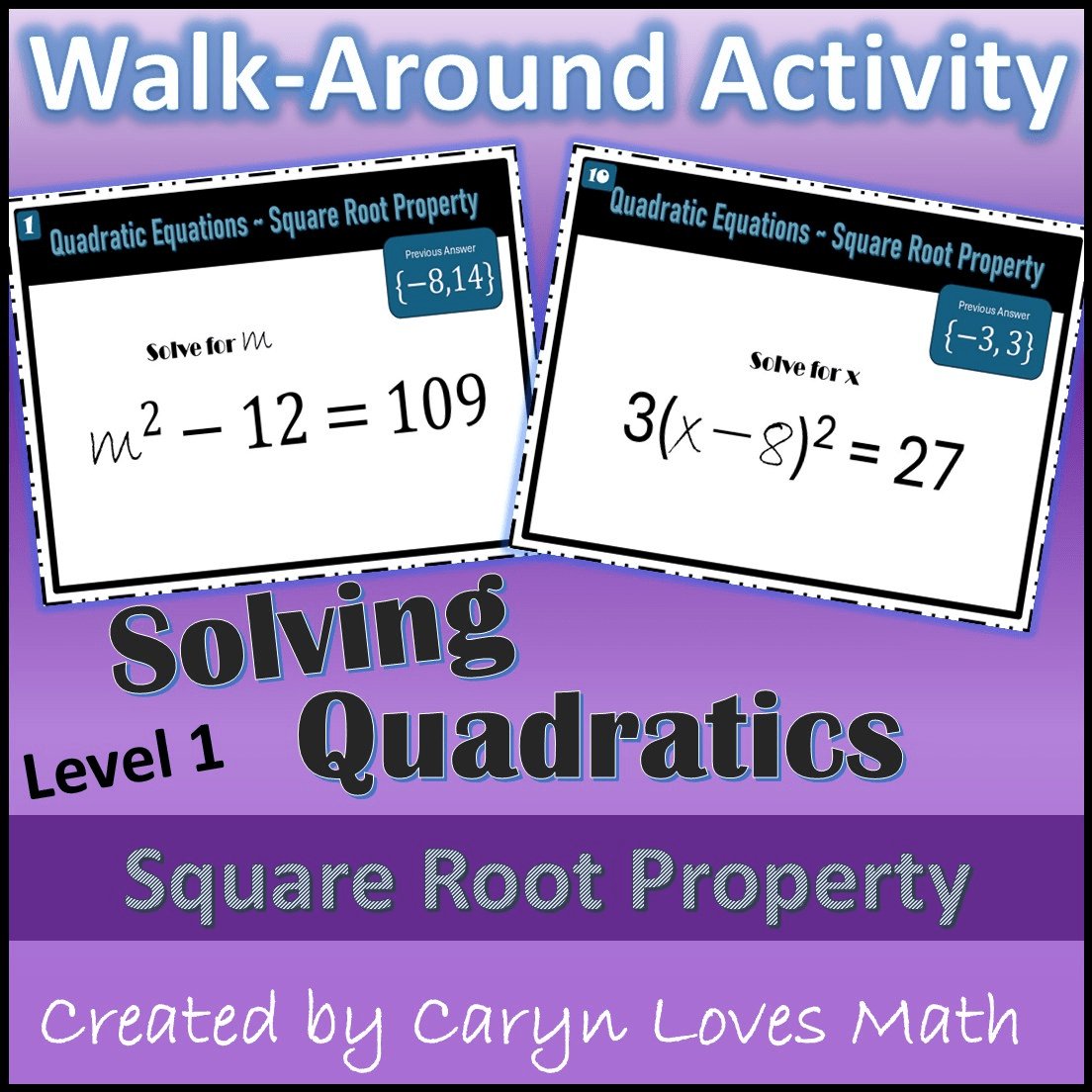
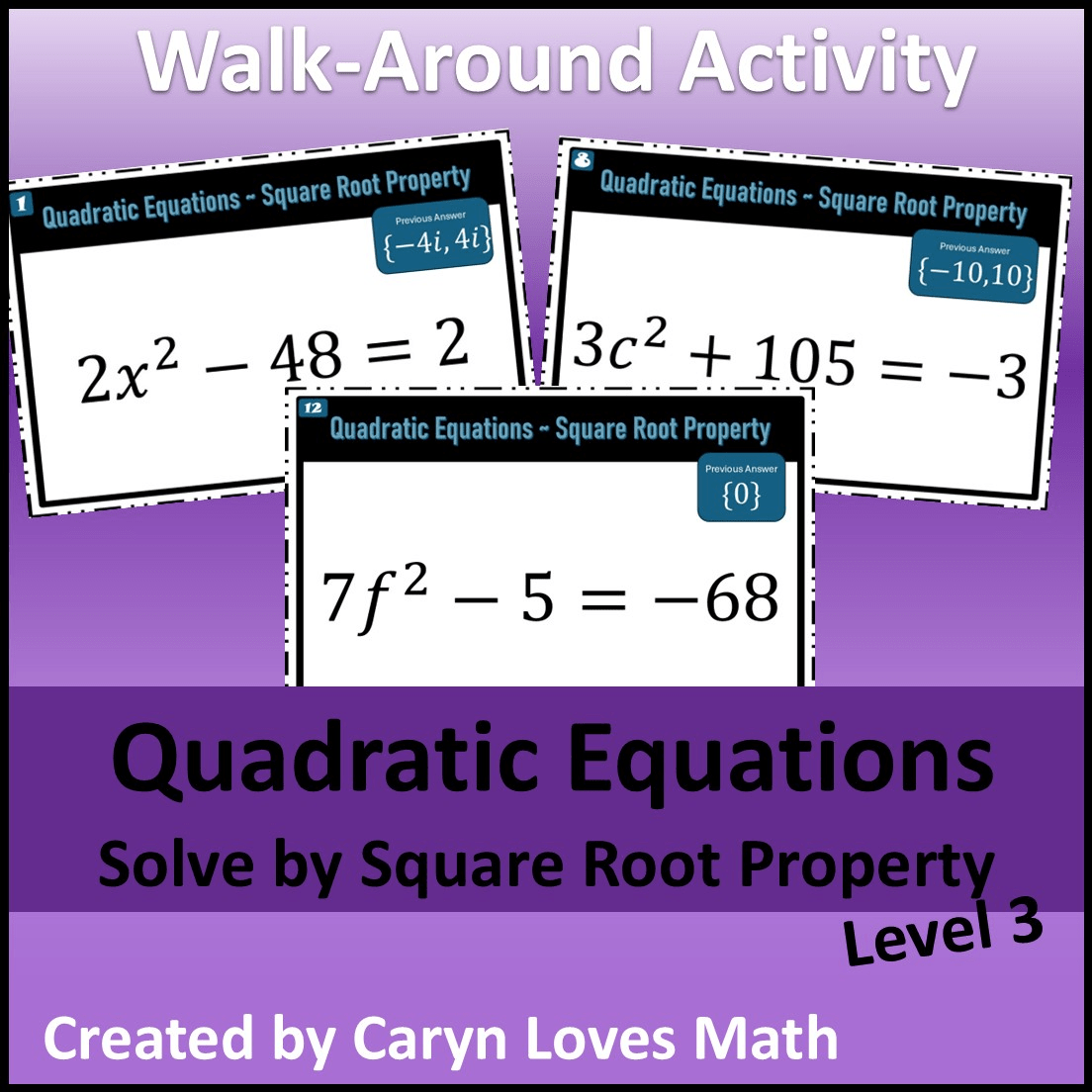
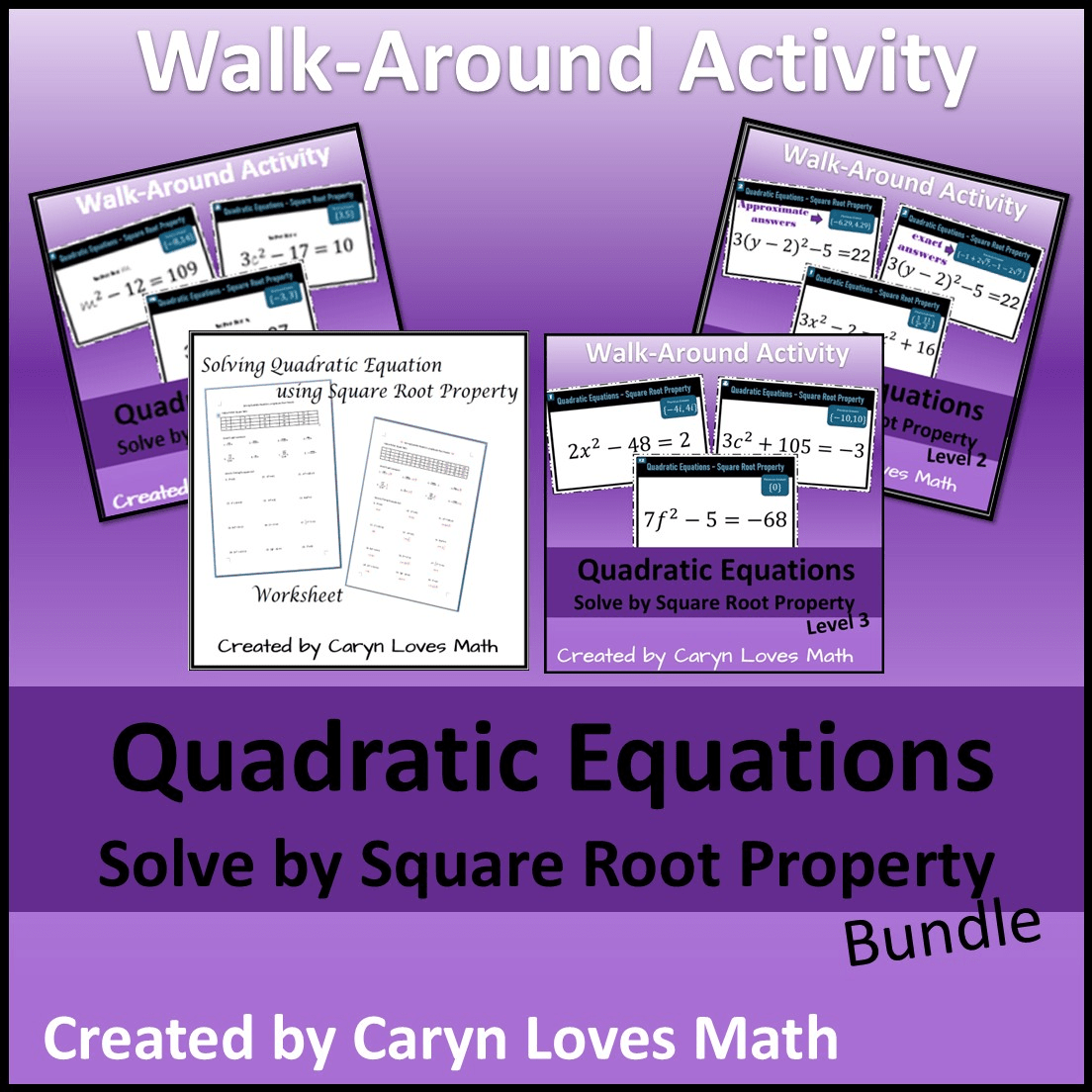
At each step, I use a walk-around activity. Students move around the room, compare their work with whoever is nearby, and justify out loud why ± is necessary — not just write it. I listen for the explanations. That’s where I hear the misconceptions I would have missed in quiet independent practice. The movement also resets their focus between steps, which matters more than I expected when each new layer adds complexity.
Walk-Around Activities for This Unit
Why This Order Matters
The square root property gets treated like a pit stop — a quick lesson on the way to the quadratic formula. But it’s doing more work than that.
It’s the first time students must consistently manage the ± symbol, irrational solutions, imaginary solutions, and increasingly complex algebraic structure.
If the order is rushed, students memorize steps and forget them just as quickly. If the order is intentional, students start seeing patterns — and patterns stick.
That one shift — from “What type of answer is this?” to “What structure am I solving?” — changed the whole unit for me. Students make fewer errors. They feel less blindsided by imaginary numbers. And when completing the square and the quadratic formula show up, they’re ready for them in a way they just weren’t before.
And when they’re ready for it, that foundation carries straight into teaching the quadratic formula — and they arrive there so much more prepared.
If you’ve been frustrated by careless errors at this stage, the sequence might be the culprit.
It was for me.