
By the time we reach the quadratic formula, my students have already solved by graphing, solved by factoring, used the square root property, and worked with imaginary numbers.
So when I introduce the quadratic formula, it’s not the first method they see. It’s the method that finally works every time — no exceptions, no special cases. That matters.
Where the Quadratic Formula Comes From
In my Honors classes, we derive the formula by completing the square — starting from ax² + bx + c = 0 and working through every step together. I’ve found that students who see where it comes from stop treating it like a magic trick and start trusting it. That trust pays off later.
Start With Rational Solutions
We always start with problems that have rational solutions — the kind students could have factored. That’s intentional. It lets us have an honest conversation about efficiency: factoring is faster when it works, but the quadratic formula never fails you.
I also love showing students how to reverse-engineer factors from the formula. If the solutions are rational, you can work backwards and reconstruct the factored form. That moment when it clicks — when they realize the two methods are connected — is worth the detour.
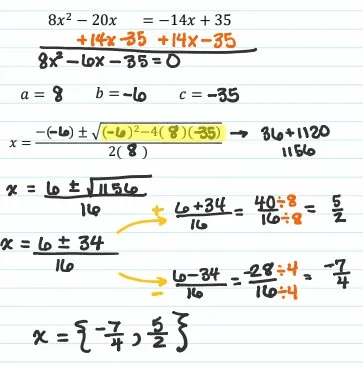
Free Quadratic Formula Template
The fill-in template I give my Algebra 2 students to glue into their notes — so the formula is always one page-flip away.
Download the Free Template →I Used to Skip the Discriminant
For years, I glossed over the discriminant. I’d mention it, move on, and wonder why students kept making careless errors. Now I treat it as its own mini-lesson — and it changes everything.
Before solving, we analyze b² − 4ac. Is it positive? Zero? Negative? A perfect square?
From that one expression, students can predict the number and type of solutions, determine whether there are x-intercepts, and decide in advance whether the equation is factorable. It’s like giving them a crystal ball before the work even begins.
We do a sorting activity — students classify equations based on the discriminant before touching the formula. The thinking comes first. The computation comes second. That order matters more than I realized.

Free Resource
Want More Quadratics Resources?
Get my quadratics review activity delivered straight to your inbox — free for algebra teachers.
Exact and Approximate — Together, Not Later
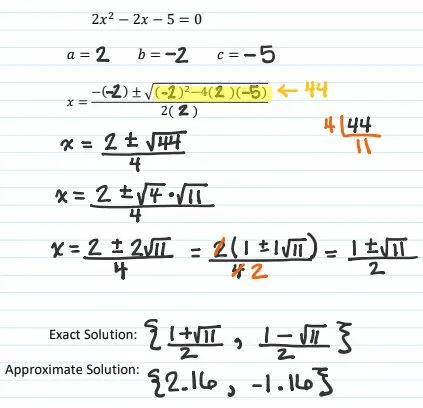
Old approach: teach exact answers, circle back to approximate answers later. New approach: both, every time, from day one.
Every time we solve, we pause and ask: does this have an approximate form? Students struggle more with this distinction than I ever expected — not the computation, but knowing when and why to approximate.
On every assessment, I include both “Exact” and “Approximate” answer lines for every problem. Students cross out the one that doesn’t apply. It sounds simple — but it forces them to make a deliberate choice rather than just writing down a number.
Differentiation in Practice
Not every class moves at the same pace, and that’s fine. Some need time to work through simplifying radical fractions like (2 + √8) / 2 before moving forward. Others are ready to dive straight into irrational and complex solutions. I follow the class, not the calendar.
Moving Into Complex Solutions
When the discriminant is negative, imaginary numbers resurface. Because we built that foundation earlier in the year, students aren’t thrown off — they’re almost expecting it. The formula confirms what they already know: two complex solutions, no real x-intercepts. It’s a satisfying payoff to months of connected teaching.
Big Picture
The quadratic formula isn’t just another method to memorize. Taught this way, it becomes the thread that ties together everything students have already learned — factoring, completing the square, the square root property, imaginary numbers, graphing. And the discriminant? It stops being just a piece of a formula. It becomes a thinking tool. That’s the goal.
If your students have been treating the quadratic formula like a black box, the discriminant might be the missing piece.
It was for mine.
📐 More From the Quadratics Series
| Post | What It Covers |
|---|---|
| Quadratic Formula | Teaching the formula and why the discriminant changes everything |
| Square Root Property | Why the order of instruction matters more than you think |
| Completing the Square | A step-by-step approach starting with patterns first |
| Matching Activities | Using the y’all do phase as a powerful check for understanding |


