
Solving Absolute Value Equations & Inequalities: The Trick That Finally Made It Click
“After years of watching students memorize three different formats for three ‘kinds’ of absolute value problems, I found one system that treats them all the same way — and it stuck.”
Absolute value equations and inequalities used to be one of those units where I felt like I was teaching three separate skills that happened to share a symbol. Equations were their own thing. “Less than” inequalities were their own thing, with their own weird combined-inequality notation. “Greater than” inequalities were their own thing too. Students would nail one format on the quiz and completely blank on the next.
Over the years I’ve built a system that treats all three the exact same way — same setup, same steps, same structure on the page — and it’s made a real difference in how confidently students move through this unit.
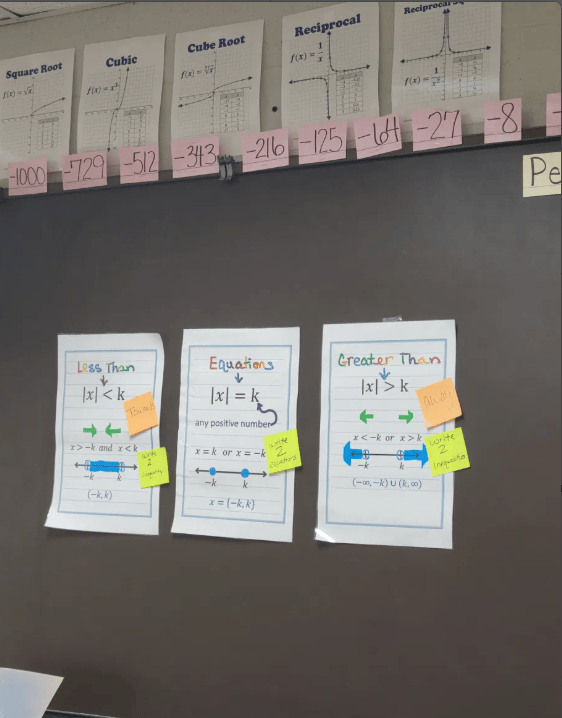
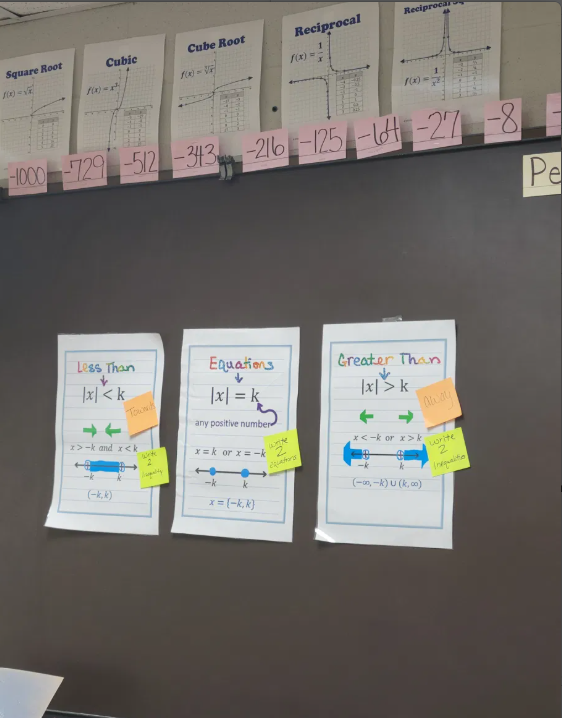
The wall posters that anchor this unit all year.
Where It Starts: Plotting the Pattern
Before any rules go up on the wall, students plot points. We test values against |x| = 5, |x| < 5, and |x| > 5 on a number line and physically mark which values work. They see for themselves that the “less than” solutions cluster between two points, while the “greater than” solutions shoot off in opposite directions — before I ever hand them a rule to memorize.
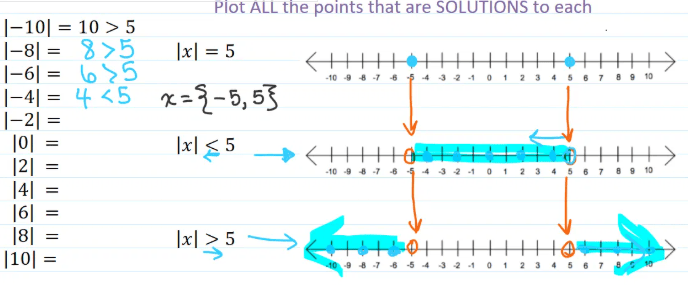
Testing values against |x|=5, |x|<5, and |x|>5 before any rule goes up.
That visual is what makes the vocabulary stick: less than means the solutions move toward each other on the number line, and greater than means they move away from each other. Once students have that picture in their heads, the rest of the unit is just formalizing what they already discovered.
The Rules, Once They See the Pattern
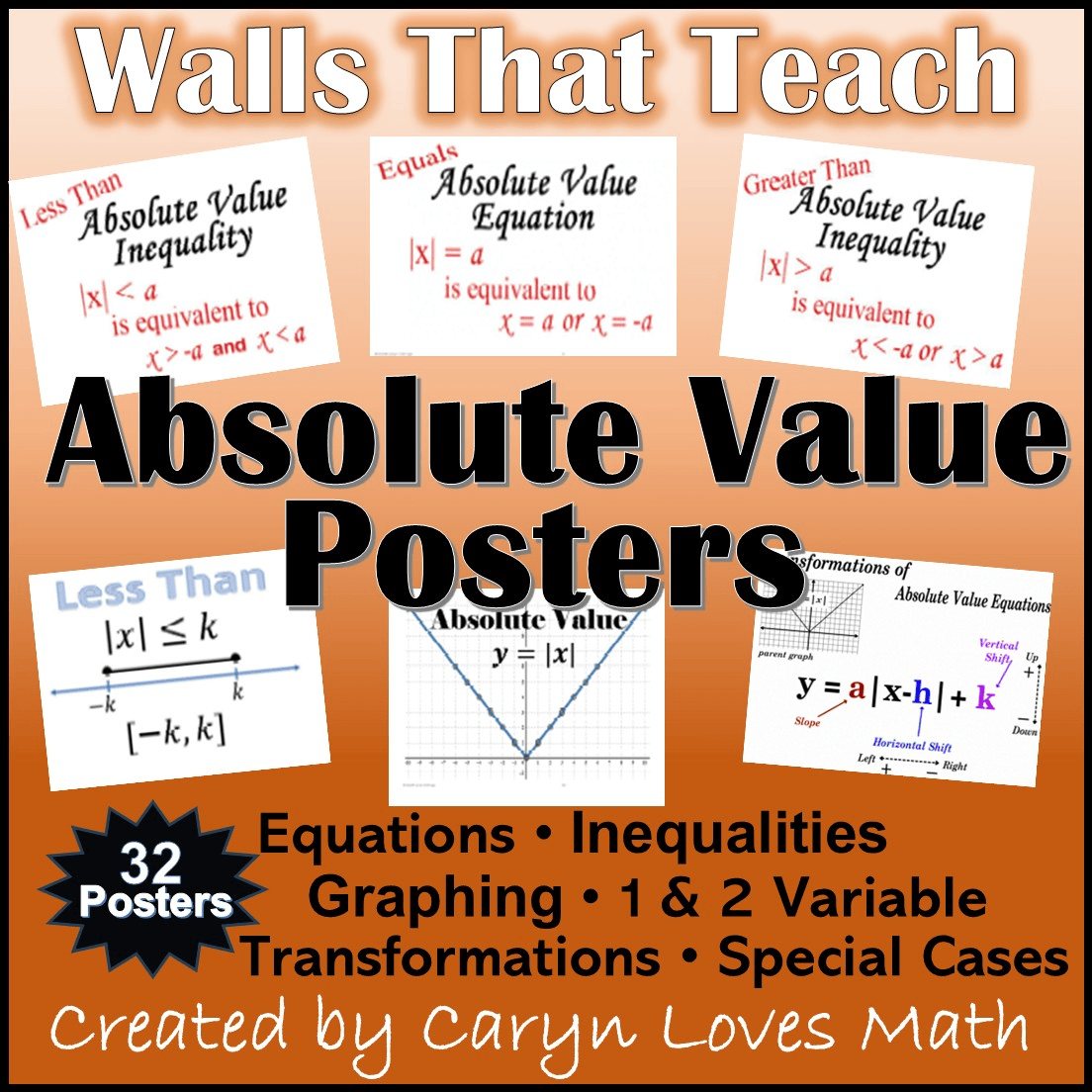
Here’s the reference chart that goes up on the wall right after the discovery activity — one poster for equations, one for “less than,” one for “greater than,” all built with the exact same structure so students can compare them side by side.

Equations, Less Than, and Greater Than — same structure, side by side.
The “A” Trick: Isolate First, Then Split
Here’s the piece that actually changed how my students approach these problems. Before splitting an absolute value equation or inequality into its two cases, we replace the entire absolute value expression with a placeholder letter — I use A. Suddenly -5|3x-7|+4=14 looks like a one-step equation students already know how to solve. They isolate A using the exact same moves they’d use for any other variable, solve for A, and then substitute the absolute value expression back in before splitting into the two cases.

Isolate and solve for A first — the rewrite comes next.
It sounds like a small shift, but it separates two skills that were getting tangled together: isolating the absolute value, and splitting it into two equations or inequalities. Students stop trying to do both at once.
I use the same substitution for equations and inequalities. And for inequalities specifically, this is also where the “flip the sign” rule for dividing by a negative shows up naturally — because they’re just dividing to isolate A, same as always.

Isolate A, solve, substitute back in, then split — flipping the inequality when needed.
Writing “And” the Same Way We Write “Or”
This is the other piece that made a real difference: I stopped teaching “less than” compound inequalities in the traditional combined form (something like 4 < x < 7). Instead, students write it out as two separate statements joined by and — using the exact same left-right structure they already use for “or” statements.
- The right side keeps its sign and number as-is.
- The left side flips the sign and negates the number.
Now “and” and “or” statements are built the same way every time, and students aren’t stuck guessing which format applies based on which inequality symbol showed up.
Free Resource: Absolute Value Transformations
Grab the free reference guide that pairs with this unit.
Get the Free Guide →
An “and” statement, written left-right just like an “or” statement.
Putting It All Together
Here’s a full example that walks through an absolute value equation and then both of its related inequalities — same isolate-and-split process each time, just a different symbol in the middle.

Same expression, three related problems — equation, “or,” and “and.”
The TroubleMakers Wall
Every unit has its edge cases — the problems that look just like the others but quietly don’t play by the same rules. In my room, those live on a poster I call TroubleMakers.
This isn’t a one-time chart just for this unit. It’s a wall that keeps growing every time we hit a new kind of special case — right now it’s got both systems-of-equations cards and absolute value cards living on it side by side. Students sort each new problem into NO or OK, and over the course of the year they start to recognize the pattern themselves: whenever a topic has a “normal” case and a “watch out” case, it gets added here.
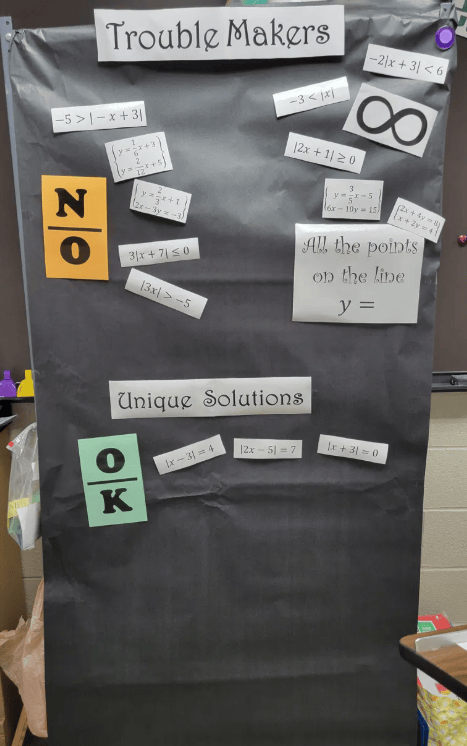
The TroubleMakers wall — absolute value’s turn.
For absolute value specifically, the trouble comes when the isolated expression equals, is less than, or is greater than a negative number — since an absolute value can never be negative. |x| = -5 has no solution. |x| > -5 is every real number. Once students have the “positive vs. negative” comparison in front of them as a rule (not just a one-off gotcha), they stop getting tripped up by it on tests.

Negative numbers: equal, less than, and greater than — no solution, no solution, and all real numbers.
(The same idea shows up when the constant is zero instead of negative — |x| = 0 still has exactly one solution, but |x| < 0 is impossible. Worth a quick mention the same day.)

Same logic, just with zero instead of a negative number.
Once students have one consistent process — isolate with the A trick, split the same way every time, and watch for the TroubleMakers — absolute value stops feeling like three different units stitched together.
It finally just feels like one skill.
Activities for This Unit
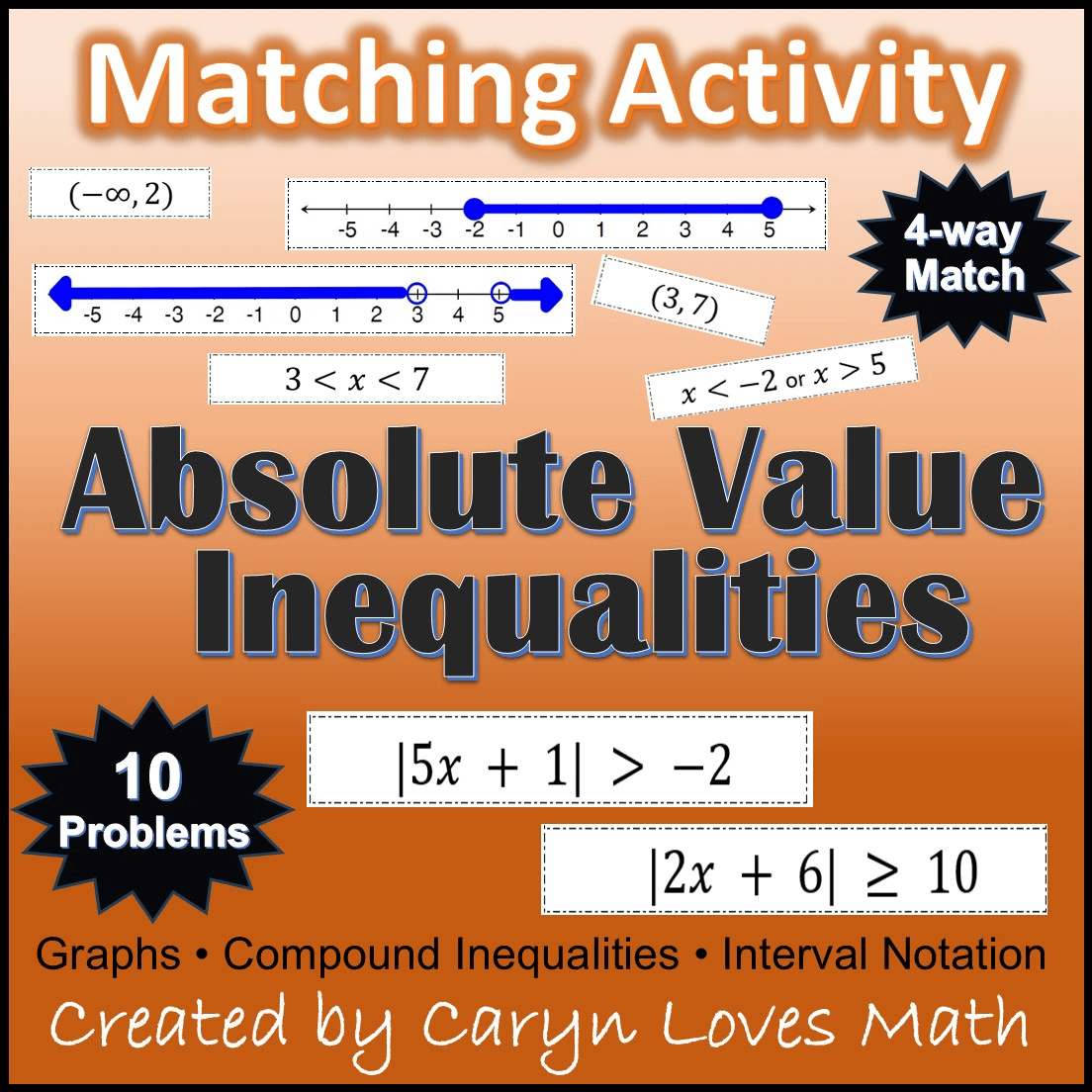
Solving Absolute Value Inequalities — Matching Activity (Compound, Interval Notation & Graphs)
View on TPT →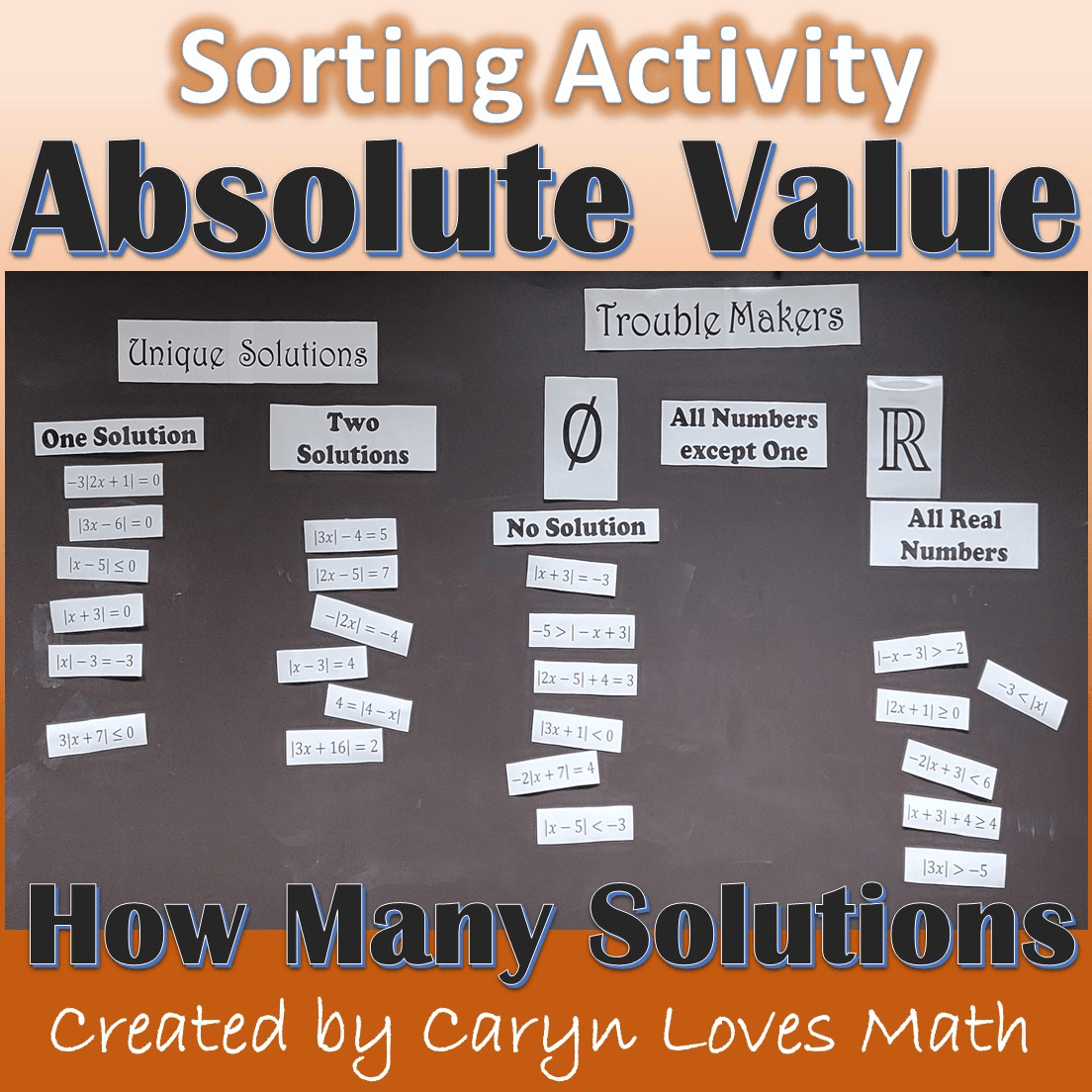
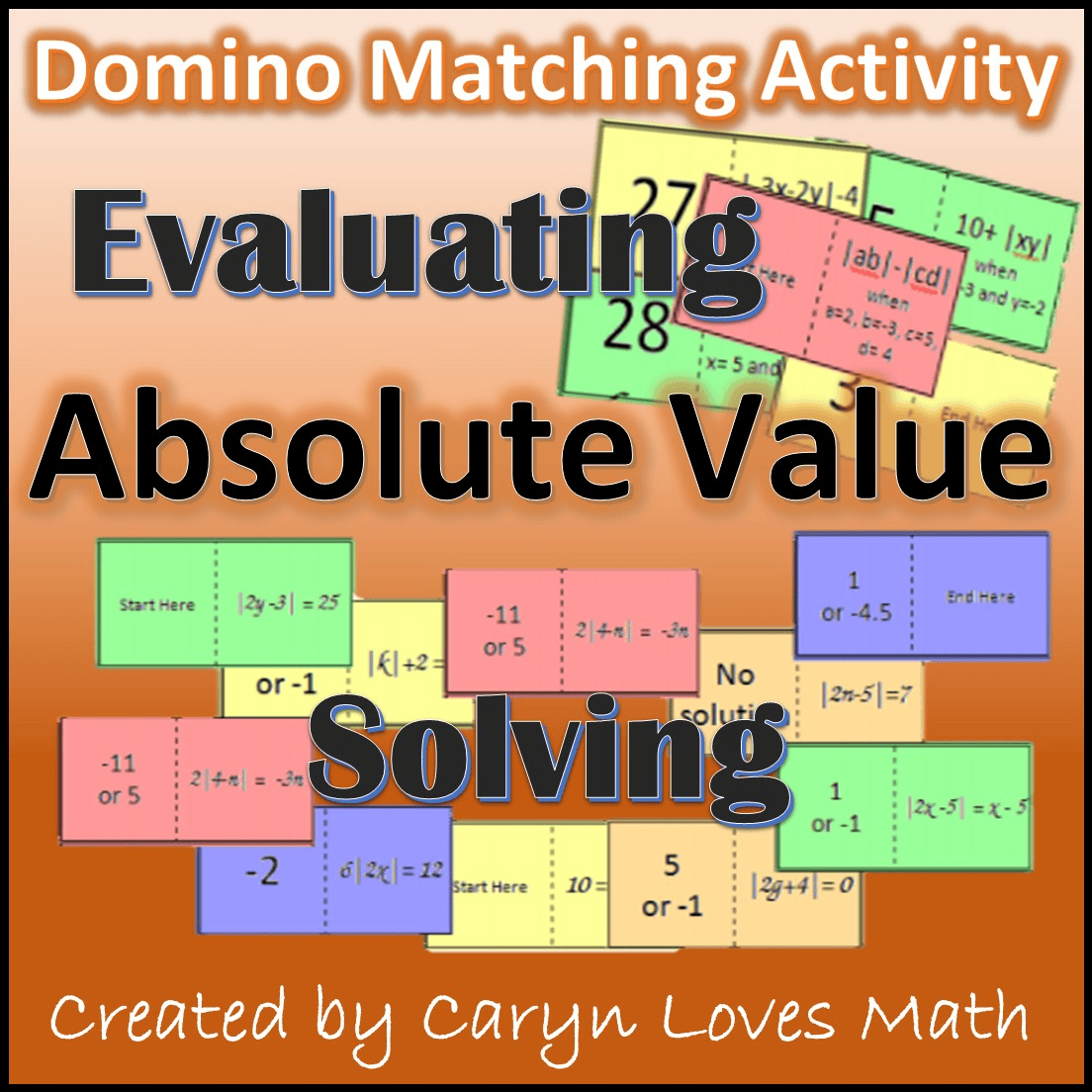
🔢 Save With the Bundle
Leave a Reply