
For most of my teaching career, I thought I knew everything there was to know about finding the area of a triangle. Half the base times the height. That’s it. Done.
Then I started teaching Geometry.
The first year, I opened the textbook and found two problems using something called Heron’s formula — a way to find the area of a triangle when you only know the three sides, no height given. I had never seen it before. I had to look it up.
A few years later, when we added a basic trig unit to all our Geometry classes — something that used to be reserved for advanced students only — I discovered a third formula. The SAS area formula. Two sides and the included angle, no height required.
By that point I realized there are actually many more area of a triangle formulas than most people ever learn. We teach three in my Geometry class, and the way I sequence them has changed significantly over the years. This post walks through how I teach all three — and why the order matters.
Area of a Triangle — Formula 1: The Classic Half Base Times Height
We always start here. Students have seen this formula before — usually in middle school — so the goal isn’t to introduce it, it’s to deepen it. I was surprised, though, by how many high schoolers didn’t remember it at all. So I treat it as a fresh start rather than a quick review.
I frame it as “half a rectangle.” Every triangle is exactly half of a rectangle with the same base and height. That visual connection makes the formula feel inevitable rather than arbitrary, and it’s something students can reconstruct on their own if they ever forget the formula on a test.

Half a rectangle — every triangle is exactly half of a rectangle with the same base and height.
We spend time on two things that students consistently struggle with:
- Identifying the correct base and height when the triangle is oriented at an odd angle
- Working backwards — finding the base or height when the area is given
The backwards problems are where I see the most errors, and they’re also where students develop real algebraic flexibility with the formula. If you only practice going forward, students treat the formula like a one-way street. Backwards problems force them to understand what the formula is actually saying.

Worked example using the classic formula.

Working backwards — finding the height when the area is given.
Area of a Triangle — Formula 2: Heron’s Formula
Heron’s formula was my first surprise as a Geometry teacher. I found it in our textbook — two problems, no context, no explanation of where it came from. The book didn’t even show example problems — they just dropped the formula in the additional problems section and left it at that. I had to do my own research just to teach it.
The formula starts with the semi-perimeter:
s = (a + b + c) / 2
A = √(s(s−a)(s−b)(s−c))
It looks intimidating at first. Students see the nested parentheses and the square root and immediately assume it’s going to be harder than it is. In practice, once they slow down and substitute carefully, it’s very manageable.
I spend time on why this formula exists — there are plenty of real-world situations where you can measure the sides of a triangle but not the height. A triangular piece of land, a triangular support structure. The formula isn’t just a math curiosity; it solves a real problem.
The semi-perimeter step trips students up most often. I’ve found it helps to write it out explicitly as its own step rather than trying to substitute everything at once.
Area of a Triangle — Formula 3: The SAS Formula
This formula came into my Geometry curriculum when we added a basic trig unit for all students. Before that, it was only taught in advanced Geometry. Once it became part of the standard curriculum, I had to figure out how to teach it in a way that made sense to students who were still building their trig foundations.
Here’s how I sequence it.
Step 1: Start With What They Already Know
We begin with a triangle where we know two sides and the included angle, but not the height. Students try to apply the classic formula — and immediately get stuck. They have the base. They don’t have the height.
I let them sit with that problem for a moment. What would you need to find the height? Can we use trig to get it?
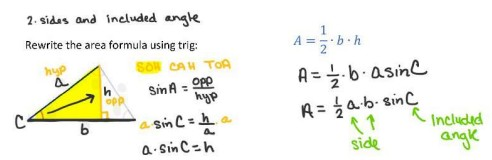
They can. Using SOH CAH TOA, if you know one side and an angle, you can find the height. So we do that. We find the height using trig, then plug it into the classic formula. It works. But it’s two steps.
Step 2: Deriving the SAS Area Formula Together
After a few problems, I ask the question: “Wouldn’t it be nice to have a formula that skips the step of finding the height first?”
Students almost always say yes.
So we derive it together. Starting from A = ½ · b · h, we use the trig relationship we already know — sin C = h/a, which means h = a · sin C — and substitute:
A = ½ · b · h
A = ½ · b · (a · sin C)
A = ½ · a · b · sin C
That’s the SAS formula. Two sides and the sine of the included angle. The derivation takes about 10 minutes. In that 10 minutes, students go from following a formula to understanding where it came from. That’s worth every minute.

The derivation — from the classic formula to the SAS formula in three steps.
Choosing the Right Formula
Once students have seen all three formulas, I put them side by side so they can see what information each one requires:
| Formula | What You Need | When to Use It |
|---|---|---|
| Classic — ½bh | Base and height | When the height is given or easy to find |
| Heron’s Formula | All three sides | When you have three sides but no height or angle |
| SAS Formula | Two sides and the included angle | When you have two sides and the angle between them |
Once students have practiced each formula individually, we bring them all together. But before they start calculating, we do a sorting activity first.
I give students a set of triangles and ask them to decide which formula applies based on the information provided — no calculating yet, just decision-making. Which formula do you have enough information to use? That classification step is where the real understanding lives.

Students sort triangles by which formula applies — before any calculating begins.
I also include a few problems that can’t be solved with any of our three formulas. Students wrestle with them for a moment, and then I mention that yes, there are other area formulas that would work here — but we don’t look at them in this course. It’s a small moment, but it signals something important: what we’ve learned is powerful, and there’s always more math beyond what fits in one unit.
This sorting activity is included as a bonus in the Area of Triangles Bundle — it’s not sold separately, but it’s one of my favorite pieces of the whole unit.
After the sort, students are ready for mixed practice. The question they need to answer before every problem is: what information do I have? The formula follows from that answer, not the other way around.

SAS and Heron’s side by side — what each formula needs and how to apply it.
Mixed Practice — Choosing the Right Formula
Once students are comfortable with each formula individually, we move to mixed practice where they have to choose the right formula based on the given information. This is where the real learning happens.
The walk-around activities I use are formula-mixed by design — students don’t know which formula they’ll need next, which forces the decision-making process every single problem. Level 2 adds another layer: some problems require using the Pythagorean Theorem to find the missing height or base before applying the area formula.

Mixed practice — students choose the right formula based on what information is given.
Free Download: Blank Notes for Area of Triangles
The blank note template I use in class — students fill it in as we work through all three formulas together. A reference they actually understand because they built it themselves.
Download the Free Notes →Activities for This Unit


The area of a triangle is one of those topics that looks simple on the surface — and it is, when you only know one formula. But when students can look at a triangle, identify what information they have, and choose the right tool for the job, something more meaningful has happened.
That’s the goal. Not memorizing three formulas — understanding when to use each one.