Why I Introduce i on Day One (And Why It Changes Everything)
“After 30 years of teaching this unit, I finally figured out what students actually struggle with — and it’s not imaginary numbers themselves.”
When I first started teaching quadratics, I followed the traditional path: quadratic equations, quadratic formula, then complex numbers as a separate unit at the very end. My students would get through the whole quadratics chapter thinking they’d mastered it — and then, surprise, suddenly we’re talking about imaginary numbers and everything feels foreign again.
I used to think that was just how it had to be. Now I know better.
The Problem With Teaching Complex Numbers Last
For decades, I taught complex numbers as a finale — something students encounter only after they’ve “earned” the right to know about them. However, that approach inadvertently sends a message: imaginary numbers are unusual. Separate. Maybe even a little scary.
As a result, students hit the quadratic formula, get a negative under the radical, and freeze. It feels like an ambush — and honestly, it is one, because we set it up that way.
The Fix: Introduce i Before You Teach Anything Else
Before I even teach the square root property, I introduce i. Not as some abstract concept to memorize — but as a number with a specific definition and specific rules.
Here’s the key insight I share with my classes on day one:
i is not a variable. It’s a number. Just like 2 is a number, i is a number.
And because it’s a number, it follows completely different rules than variables do. That distinction is everything — and if students miss it early, they’ll make the same errors all unit long.

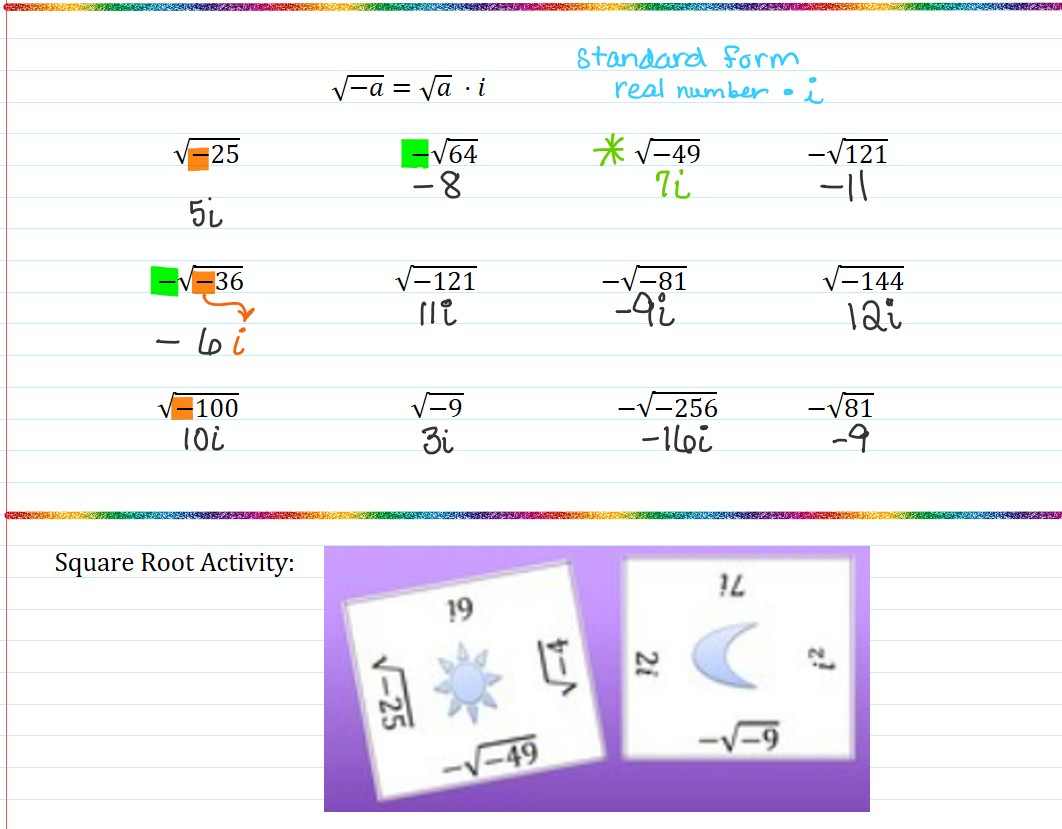
√(−a) = √a · i — and why that changes everything about how students see imaginary numbers.
Want to Use These Notes With Your Class?
I’ve made my editable OneNote notes for this lesson available to download. Use them as-is or customize them to fit your students — the scaffolded examples, color coding, and practice problems are all included.
Download the OneNote File →Why the Sequence Matters
When students first encounter the square root property, they learn: if x² = 4, then x = ±2. Simple. But what happens when they hit x² = −4?
In the traditional sequence, this moment comes much later and it feels like an exception. A trick. Something new to survive.
In my classroom, however, it doesn’t. Because we’ve already talked about i, when we encounter √(−4), students already know: √(−4) = 2i. It’s not an exception. It’s just what happens when you take the square root of a negative number. We’ve been doing this all along.
The i² Rule: Why It’s Non-Negotiable
This is where the “number vs. variable” distinction becomes crucial — and where I see the most mistakes if I haven’t been explicit about it early.
If a student writes an answer like 3i², I stop them right there. You can’t leave it that way. Since i is a number and i² = −1, then 3i² becomes 3(−1), which is −3.
I use an analogy that clicks immediately: you can’t leave 2² as 2² — you simplify it to 4. Students already understand that instinctively. Once they realize i works the same way, the hesitation disappears. The fear evaporates. It’s not a special rule for a scary new concept. It’s the same rule they’ve always known, applied to a new number.
Free Resource: Quadratics Solving Review
Working through the quadratics unit right now? Grab my free review activity — covers the square root property, completing the square, and the quadratic formula all in one place, with answer key included.
Get the Free Review Activity →How My Teaching Sequence Flows Now
Once students have the foundation — i is a number, i² = −1, you always simplify — here’s the order that makes everything else click into place:
- Introduce i — i² = −1. That’s the whole definition. Start there, and spend real time on it before moving forward.
- Square root property with imaginary solutions — When we solve x² = −4, we get x = ±2i. We’re not making an exception. We’re applying what we already know.
- Simplify all square roots together — √8 simplifies to 2√2. √(−8) simplifies to 2i√2. The process is identical — we just handle the i alongside everything else. Teaching them together instead of separately is the key.
- Powers of i — Students discover that i² = −1, i³ = −i, i⁴ = 1, and the cycle repeats. These aren’t tricks to memorize. They’re logical consequences of i being a number with a specific definition.
- Standard form as a natural extension — By the time we write complex numbers in a + bi form, it feels like the next logical step, not a brand new concept dropped from nowhere.

i² = −1, i³ = −i, i⁴ = 1 — not tricks to memorize, but logical consequences of what i actually is.
The Payoff
By the time we circle back to the quadratic formula and discover that some quadratics have complex solutions, my students don’t panic. Because they’ve been working with i for weeks, it’s not new. It’s not scary. It’s just part of the landscape.
As a result, when we write those final solutions in standard form, they do it confidently — because they’ve internalized from day one that imaginary numbers are numbers. Not some separate, exotic math hiding at the end of a unit.
In nearly 30 years of teaching, I’ve found that this one shift — introducing i early and framing it as a number rather than a concept — does more for student confidence in this unit than anything else I’ve tried.
Up next in this series: once students are solid on imaginary numbers, the natural next step is operations on complex numbers — adding, subtracting, multiplying, and dividing in standard form. That post is coming soon.
If your students have been treating imaginary numbers like a detour at the end of the unit, introducing i on day one might be the missing piece.
It was for mine.
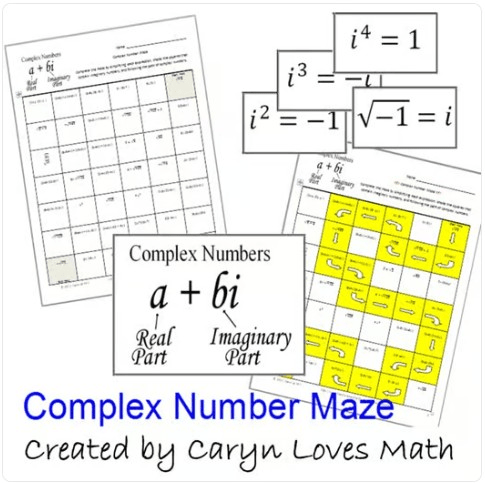
Complex Numbers Maze Activity
Students practice identifying real and imaginary parts in a + bi form while navigating the maze. One of my most downloaded free resources — and a perfect early introduction activity.
Download Free →Activities for This Unit

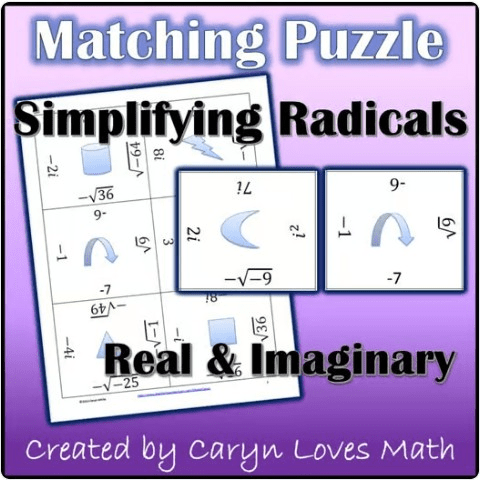


📐 More From the Quadratics Series
| Post | What It Covers |
|---|---|
| Quadratic Formula | Teaching the formula and why the discriminant changes everything |
| Square Root Property | Why the order of instruction matters more than you think |
| Completing the Square | A step-by-step approach starting with patterns first |
| Matching Activities | Using the y’all do phase as a powerful check for understanding |
| Imaginary Numbers (this post) | Why introducing i on day one changes the whole unit |
🔢 Bundles for the Quadratics Unit