
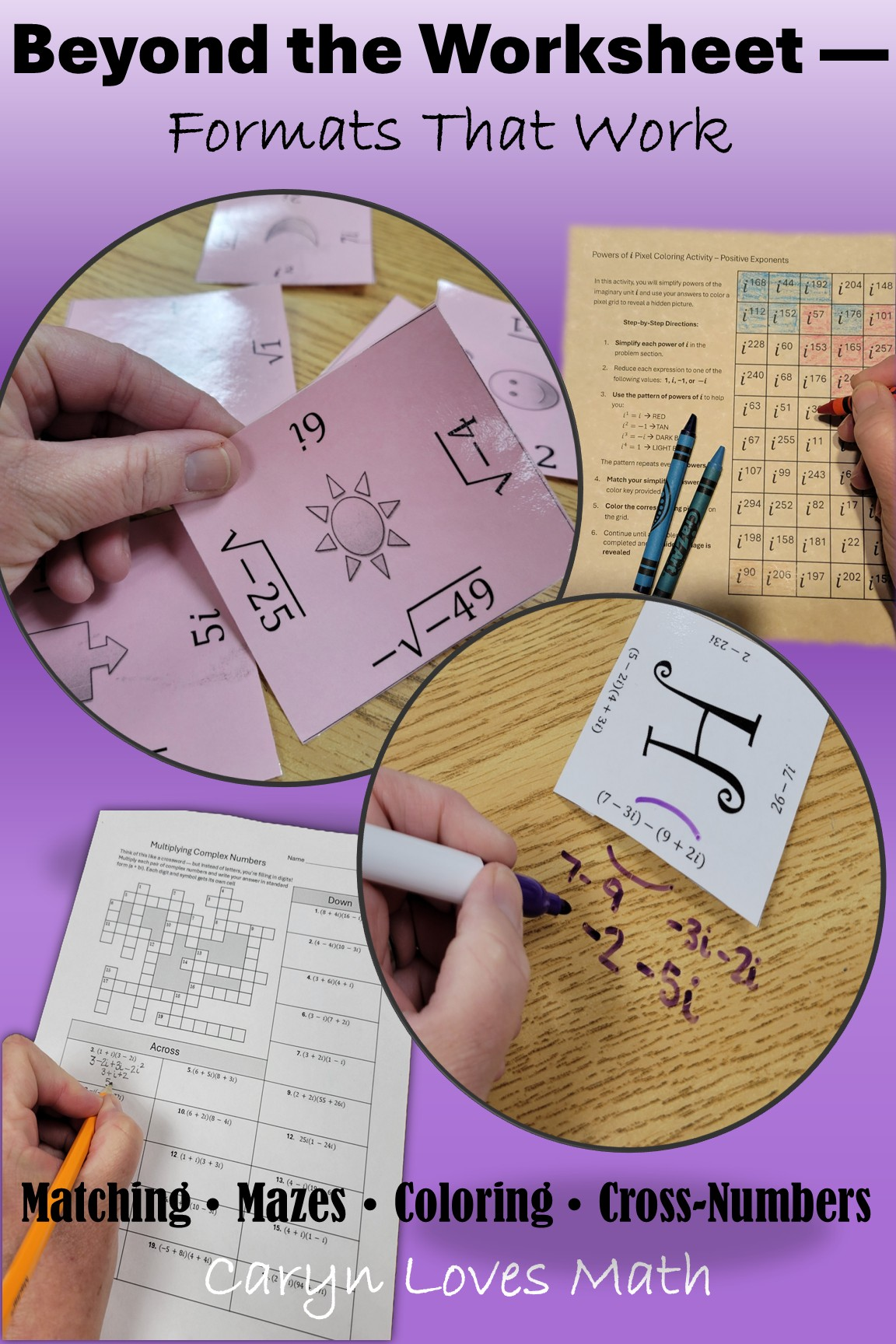
Every year, the same thing happens when we get to complex numbers. Finding complex number activities that actually work — not just keep students busy — is harder than it sounds. Students who have been confident all unit suddenly look at me like I’ve started speaking a different language. And honestly? I get it. Imaginary numbers feel abstract in a way that even irrational numbers don’t.
What I’ve found over the years is that the content isn’t usually the problem — the practice format is. Traditional worksheets ask students to grind through 20 problems in silence, and complex numbers especially need a different approach. Students need to check their own work, talk through their reasoning, and have something to show them immediately when they’ve made an error.
Here are six activity formats I keep coming back to — and why each one works particularly well for this unit.
1. Matching Puzzles
Matching activities are where I hear the best math conversations in my classroom. I use them during the “y’all do” phase of my lesson — after I’ve modeled and we’ve practiced together, but before students work independently.
The format creates built-in accountability without creating anxiety. If every card has exactly one match, students know when something is wrong before they ask me — and they’re more likely to go back and check their work than to sit and wait. That independence matters especially with a topic that shakes confidence as quickly as complex numbers can.
What I listen for isn’t just correct answers — it’s how students talk through disagreements. “I got 2 + 3i but you got 2 − 3i — let’s see whose right.” That kind of exchange is worth more than ten silent worksheets.

Students matching complex number expressions during the y’all do phase.
Try It

Operations on Complex Numbers Matching Puzzle
View on TPT →
Simplifying Square Roots Matching Puzzle
View on TPT →
Simplifying Square Roots · Google Slides
View on TPT →2. Cross-Number Puzzles
Cross-number puzzles are structured like a crossword, but with math expressions instead of words. Students solve problems and enter their answers digit by digit into a grid — and because answers share squares with adjacent problems, one wrong digit throws off everything around it.
This is my secret weapon for students who think they’re done when they’re not. The format demands a level of accuracy that a regular worksheet doesn’t — and it sends students back to check their arithmetic without me saying a word. The grid catches the error; I just watch it happen.
Complex number operations are a perfect fit for this format because the answers involve both real and imaginary parts, giving the grid plenty of digits to work with. I now have all four operations covered — multiplication, division, and adding & subtracting.

The grid catches errors before students even raise their hand.
Try It

Multiplying Complex Numbers Cross-Number Puzzle
View on TPT →
Dividing Complex Numbers Cross-Number Puzzle
View on TPT →Adding & Subtracting Complex Numbers Cross-Number Puzzle
View on TPT →📦 Save with the Bundle
Operations on Complex Numbers Cross-Number Puzzle Bundle
All 3 puzzles — Multiply, Divide, Add & Subtract →3. Coloring Activities
Coloring activities get dismissed sometimes as being too elementary for high school — but I’d push back on that. For a topic as abstract as complex numbers, a low-stakes format that lets students focus purely on the math without the pressure of a grade or a timer can be exactly what the room needs.
The way these work: students solve problems and use their answers to determine which color goes in which section of a grid or image. A wrong answer produces a color that doesn’t belong — which is its own self-checking mechanism. Students notice when something looks off and go back without being told to.
I also find that coloring activities change the energy in the room. Students who are usually tense during complex number practice settle in. That shift in atmosphere is worth something, especially mid-unit when confidence is fragile.

Powers of i pixel coloring — wrong answers show up in the wrong color.
Try It
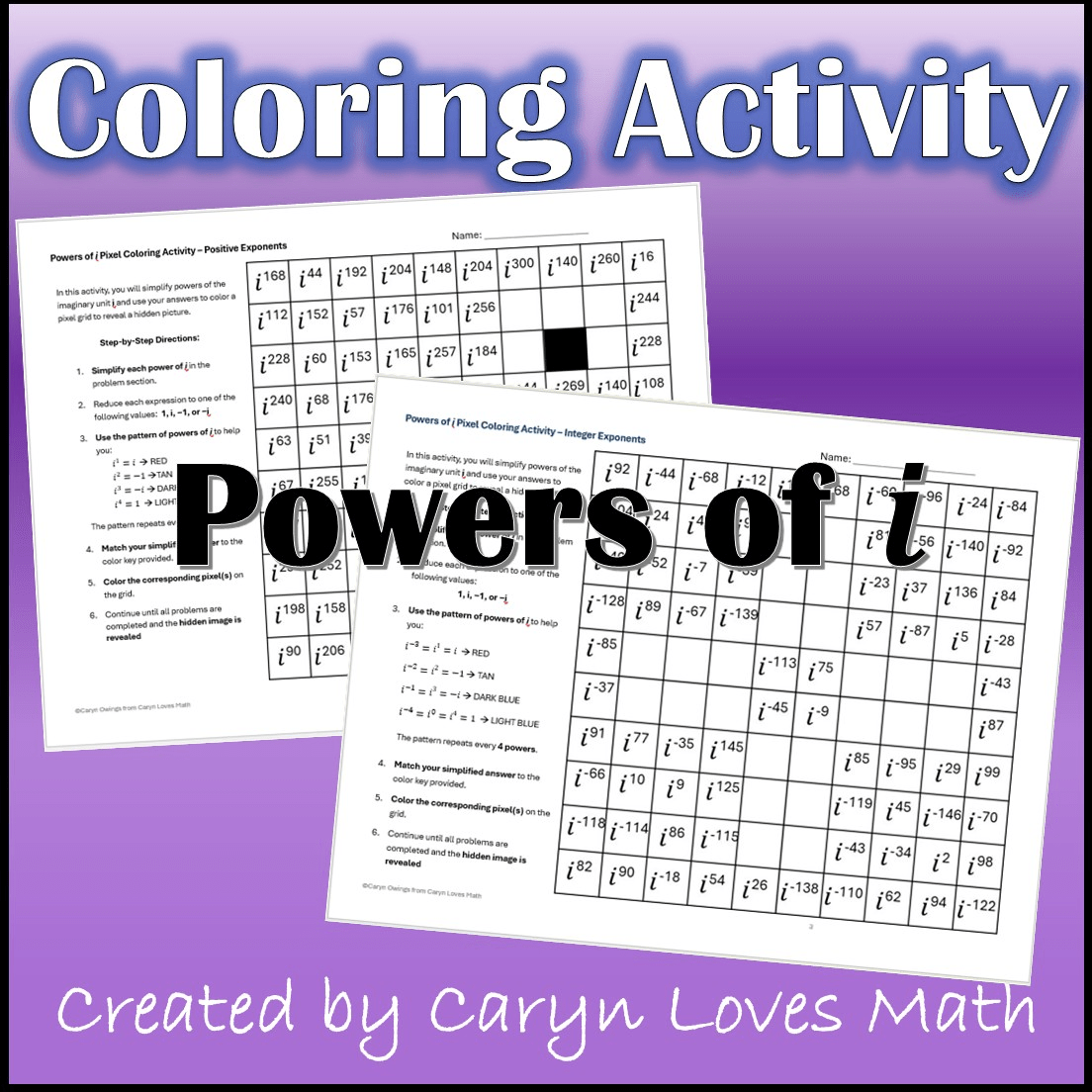
Powers of i Pixel Coloring Activity
View on TPT →Free Resource: Quadratics Solving Review
Get my free quadratics review activity delivered straight to your inbox — perfect for Algebra 2 teachers.
Get the Free Resource →4. Mazes
Mazes are self-checking by design. Students solve each problem and follow their answer through the maze — and if they make an error, they hit a dead end. They know immediately that something went wrong, without waiting for me to look at their work.
For complex numbers specifically, this format works well because the errors tend to be procedural — a sign flip, a forgotten i, a simplification step skipped. The maze catches those quickly and sends students back to find them. That immediate feedback loop is hard to replicate with a traditional worksheet.
I also use mazes as my go-to sub day activity. Print and go, no explanation needed — and I always include the answer key so the sub can redirect a stuck student without having to solve the problems themselves.
Try It

Complex Numbers Maze FREE
Download on TPT →5. Sorting Activities
Sorting activities slow students down in exactly the right way. Instead of executing a procedure, they have to make a decision — and then justify it. That shift from doing to deciding is where real understanding shows up.
For simplifying square roots and powers of i, sorting works especially well because the distinctions students need to make are conceptual, not just computational. Is this already simplified? Does this belong with the real numbers or the imaginary ones? Sorting forces those questions into the open.
I listen to the conversations during sorting more than during any other activity. That’s where I hear the misconceptions before they show up on assessments. Both print and digital versions work well here — the digital version is particularly useful for absent students or 1:1 classrooms.
Try It


6. I Have, You Have Games
If you haven’t used this format before: each student gets a card that says “I have ___” (an answer) and “Who has ___?” (a new problem). One student reads their card aloud, the student whose “I have” matches calls out next, and the chain continues around the room until it loops back to the start.
For complex numbers, this format works beautifully because it keeps every student accountable at all times. There’s no checking out — anyone’s card could be called next, and the whole class hears each answer read aloud. That repetition of hearing simplified complex expressions spoken out loud does something that silent practice doesn’t.
It’s also naturally differentiated. Students who process quickly can use the wait time to check their own simplification. Students who need more time have the natural pause built in. And the game format makes the whole thing feel lower-stakes than a worksheet — which helps with a topic that tends to intimidate.
I’m currently building an I Have, You Have game specifically for complex number operations. I’ll link it here once it’s available.
📦 Want Everything in One Place?
Complex & Imaginary Numbers Bundle — 10 Activities
All formats, all operations — Algebra 2 & PreCalc →Complex numbers have a reputation for losing students. In my experience, the content isn’t usually the problem — it’s the practice.
When students have a format that checks their work, gets them talking, and doesn’t feel like another worksheet, the topic clicks in a way that surprises them.
Start with whichever format fits your class right now — and build from there.
🜐 More From the Imaginary & Complex Numbers Series
| Post | What It Covers |
|---|---|
| Why I Introduce i on Day One | How introducing imaginary numbers early changes the whole unit |
| 6 Activity Formats for Complex Numbers (this post) | Why these formats work — and examples from my own classroom |