
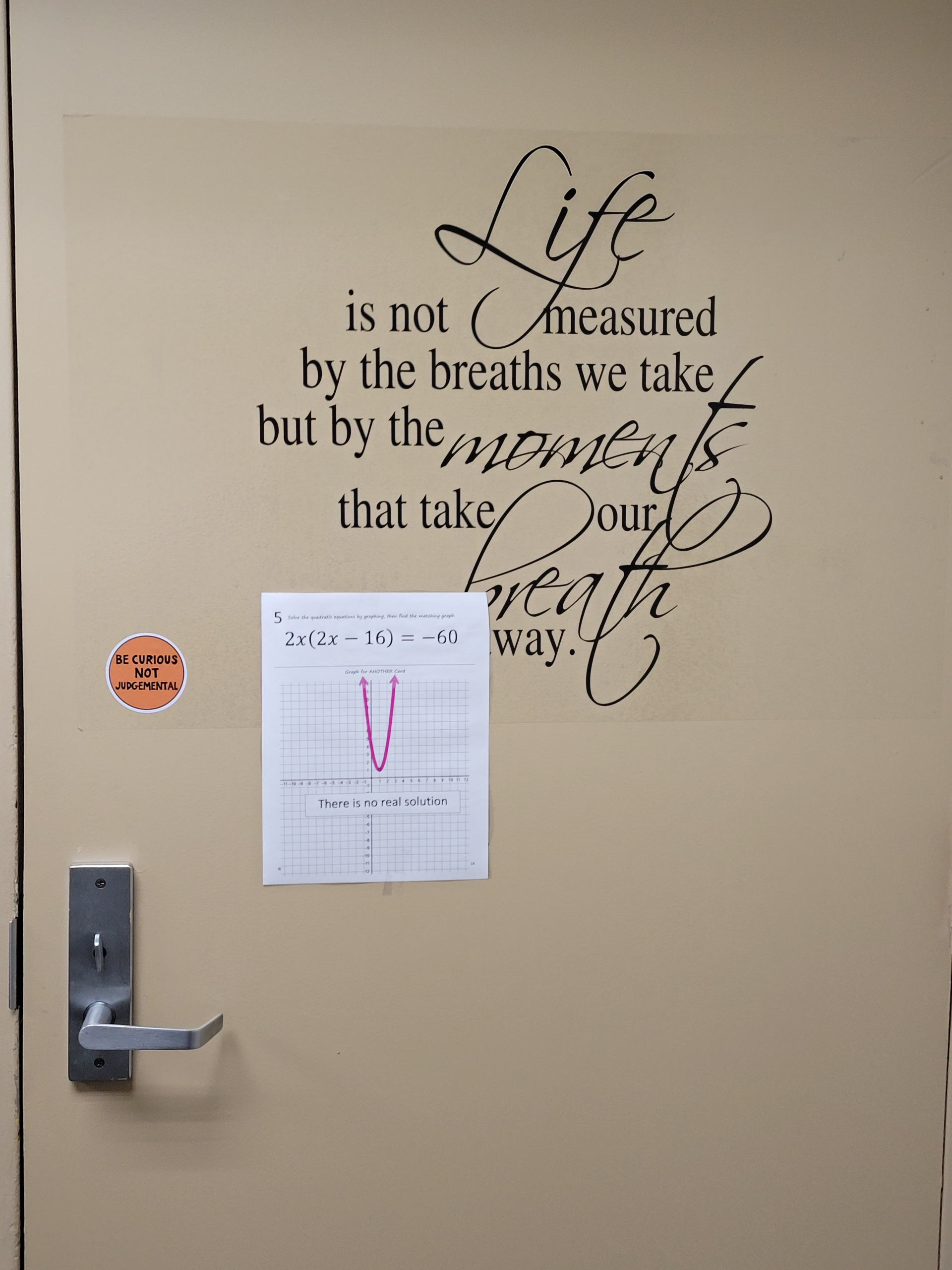
There’s a good chance you’ve heard of this format under a different name. Some teachers call it a scavenger hunt. Some call it a gallery walk. Some just call it “the card activity.” I call it a walk-around activity, and I’ve been using it in my Algebra classroom for years across every unit I teach.
If you’ve never tried one, or if you’ve tried something similar and weren’t sure it was worth the setup, this post breaks down exactly what a walk-around activity is, how it’s different from the formats you might already be using, and why it’s become the practice format I reach for more than anything else.
What a Walk-Around Activity Actually Is
A walk-around activity is simple in concept. A set of cards — usually 12 — are posted around the room. Each card has a problem on it and an answer to a different problem. Students start at any card, work the problem, and then look for their answer on another card posted somewhere in the room. When they find it, that’s their next problem. The chain continues until they’ve worked their way back to the card they started on.
That last part is important: the activity is self-completing. If students work through all the cards and end up back where they started, they know they did everything correctly. If they can’t find an answer, they know immediately that something went wrong — without me having to check their work.
That’s the whole format. Print, hang, walk, solve, self-check. Once students understand how it works — which takes about five minutes the first time — I barely have to explain it again for the rest of the year.

Students work the problem, find their answer on another card, and keep moving.
How It’s Different From Other Formats You Might Already Use
| Format | How It Works | Key Difference from Walk-Around |
|---|---|---|
| Task Cards | Individual problems students work through one at a time, usually seated | No self-checking — students can get every problem wrong and not realize it |
| Gallery Walk | Content posted around the room, students respond or discuss | Discussion-based, not designed for math practice or self-checking |
| Stations | Multiple different activities covering different concepts, students rotate on a timer | Breadth across topics vs. depth on one skill |
| Scavenger Hunt | Same answer-chain structure as a walk-around | Essentially the same format — just a different name |
A Closer Look: Task Cards vs. Walk-Arounds
Task cards are probably the closest comparison. Same idea: a set of individual problems students work through one at a time. But task cards have no built-in self-checking mechanism. A student can work through 20 task cards, get half of them wrong, and not realize it until you grade them.
With a walk-around activity, the activity itself is the check. If a student gets a problem wrong, they can’t find their answer on any card in the room. The mismatch is immediate and obvious. Students catch their own errors in real time — which is a fundamentally different experience than handing in a task card set and waiting to find out.
Stations vs. Walk-Arounds
Stations and walk-arounds both involve movement, but they’re doing different things. In a station setup, each station is a different activity covering a different concept. Students rotate through on a timer, and the goal is breadth — touching multiple skills in one class period.
A walk-around activity focuses on one concept at a time. All the cards cover the same skill, just with different problems. The goal is depth and repetition. I use both formats, but for different instructional purposes. Walk-arounds are for building fluency. Stations are for review across multiple topics.
That said, I sometimes use a shorter walk-around — just 6 cards, hung in one corner of the room — as one of my stations during a review day. It fits naturally into the station structure and gives that station the same self-checking benefit students get from a full walk-around.
Scavenger Hunt vs. Walk-Around
This is essentially the same format — problems posted around the room, answer chain structure, self-checking. You’ll see “scavenger hunt” used on TPT and in curriculum materials. I call it a walk-around in my classroom, but if you’ve used scavenger hunts before, you already know this format.
One variation you’ll sometimes see: some teachers hide the cards to make the activity more challenging — tucking them under desks, posting them in the hallway, or placing them in less obvious spots. It adds an element of searching that some students love. I keep mine visible and posted at eye level, but it’s a fun variation worth knowing about.
Why the Walk-Around Activity Format Works
The Self-Checking Mechanism Changes Everything
When students do a worksheet or a set of task cards, they can be wrong for the entire period and never know it. The error doesn’t surface until I grade it — at which point we’ve moved on and re-teaching feels like going backwards.
When students do a walk-around activity, errors surface immediately. A student who gets a problem wrong can’t find their answer. They go back, check their work, try again. This happens naturally, without me having to intervene. By the time I come around to check in, students have often already found and corrected their own mistakes.
That shift — from me catching errors to students catching their own errors — is the most valuable thing the format does.
Movement Helps More Than You Might Expect
I used to think the movement was just a nice bonus — students enjoy it, it breaks up the period, fine. But I’ve come to see it as genuinely instructional.
When students move to a new card, there’s a natural reset. They’re not staring at the same page they’ve been on for 20 minutes. The act of getting up, walking across the room, and finding the next card creates a small break that seems to refresh their focus. I see students engage with problems 8, 9, and 10 with the same attention they brought to problems 1 and 2. That doesn’t happen on a worksheet.
What About Students Who Don’t Like Moving?
Not every student enjoys walking around the room — and that’s worth planning for. Some students find the movement distracting, some have social anxiety about moving through a crowded room, and some just genuinely prefer to work at their seat.
I handle this two ways. The first is the same approach I use for absent students: print the activity 6 problems to a page and let the student complete it at their table. Same problems, same self-checking answer chain, no movement required. It’s a simple accommodation that takes about 30 seconds to set up.
The second option works well when only one or two students prefer to stay seated: make sure the font on the cards is large enough that students can read the problems from their desks. If a student can see all the cards from where they’re sitting, they can participate in the activity without getting up at all.

Print multiple per page and cut — instant tabletop version for students who prefer to stay seated.
Free Resource: Solving Quadratics Review Walk-Around
Want to try the walk-around format in your classroom? Get my free solving quadratics review activity — covering factoring, square root property, and the quadratic formula in one self-checking walk-around.
Once They Know the Format, the Activity Runs Itself
The first time students do a walk-around activity, there’s a learning curve. What do I do when I find my answer? What does it mean if I can’t find my answer at all?
By the second or third time, those questions are gone. Students pick up a card, start working, and the format is invisible. That invisibility is valuable — it means students’ cognitive energy goes entirely to the math, not the logistics of the activity. Every subsequent walk-around in the year benefits from the investment you made in explaining it the first time.
One question that does come up occasionally: “What does it mean if I get back to my starting card before I’ve done all the problems?” It means a student has followed an incorrect answer at some point and jumped ahead in the chain. They need to go back and find where they went off track. It’s a useful moment — the activity has already told them an error exists before they even realized it.
This is also what makes walk-arounds my favorite activity for sub days. Once students know the format, the sub doesn’t need to explain anything. Print the cards, put them up, and the activity runs itself.
It Works Across Every Topic I Teach
I teach a lot of different topics in Algebra 2 — graphing, solving equations, quadratics, complex numbers, piecewise functions, and more. The walk-around format works for all of them. The structure doesn’t change; only the problems do.
That consistency is something I didn’t fully appreciate until I’d been using the format for a few years. When students encounter a walk-around in October on absolute value and then again in February on completing the square, they don’t have to learn anything new about how the activity works. They can just do math.
A Few Practical Notes for Trying a Walk-Around Activity
- Print cards on cardstock if you can — they hold up much better over multiple uses.
- Slide them into protective sleeves before hanging. The sleeve protects the card and makes reuse easy.
- Students can start at any card — you don’t need to manage who starts where.
- If a student can’t find their answer, that’s the signal to go back and check their work. Resist the urge to just tell them the answer.
- The 6-card version works well for bell ringers or targeted review. The 12-card version is better for full practice or homework.
I’ve written more about setup, storage, and adapting walk-arounds for large classes and students who can’t move around the room in a separate post if you want the full picture. And if you want to try one without building your own, there are thousands of walk-around activities available on Teachers Pay Teachers — search any math topic plus “walk-around” and you’ll find options.
If you’ve been looking for a practice format that does more than keep students busy — one that catches errors in real time, keeps students focused, and runs itself once they know it — this might be it.
Pick a topic you’re teaching next week and try one.
🜐 More From the Walk-Around Series
| Post | What It Covers |
|---|---|
| What Is a Walk-Around Activity? (this post) | How it works and why it’s the format I use most |
| Graphing Walk-Around Activities | Setup, storage & pro tips for using them all year |
| Station Review for Quadratics | How I use a 6-card walk-around as one of my review stations |